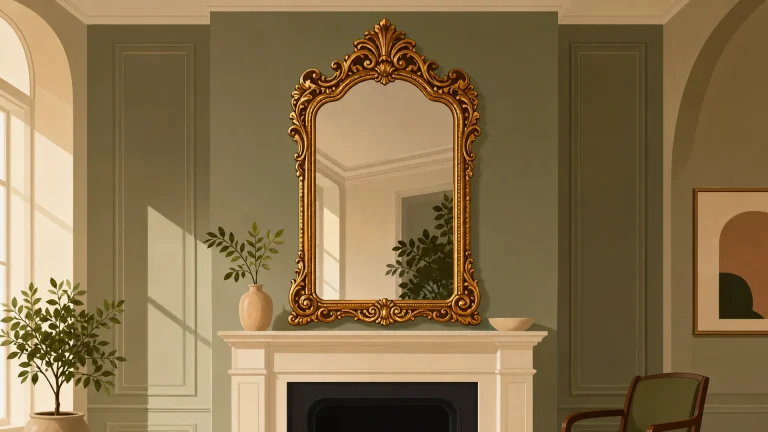
You’ve found the perfect sideboard. You’ve found a mirror you love. And yet, hung up on the wall, something feels off. Maybe it sits too high, floating away from the furniture below. Maybe it crowds the surface, leaving no breathing room at all. That small gap between the top of your server and the bottom of your mirror carries more weight than most people expect.
Why Mirror Height Above a Sideboard Matters So Much
A room reads as balanced or unbalanced within seconds of walking in. Mirror height above a sideboard is one of the quiet decisions that decides which one you get. Hang it wrong, and the eye keeps drifting to the awkward gap. You might not be able to say why the space feels unsettled, but you’ll feel it.
At Furnicare, customers ask us this exact question all the time, usually when they’re pairing one of our sideboards or credenzas with a new mirror. It’s one of the most common styling dilemmas in South African living and dining rooms. Get the height right, and the mirror and furniture stop looking like two separate purchases. They start looking like one considered vignette.
The visual balance problem most homes get wrong
The most common mistake is treating the mirror and the sideboard as unrelated decisions. People pick a mirror because they like its frame, then hang it wherever it fits on the wall. But a mirror above a server should relate to the furniture beneath it the way a headboard relates to a bed. The two need to feel chosen together, not stacked as an afterthought.
This is really a subset of a bigger question: where should any mirror sit on any wall. If you want the fuller picture beyond sideboards, our guide to mirror placement tips for small rooms covers how mirrors behave in tighter dining and hallway spaces.
The General Rule for Hanging a Mirror Above a Server or Sideboard
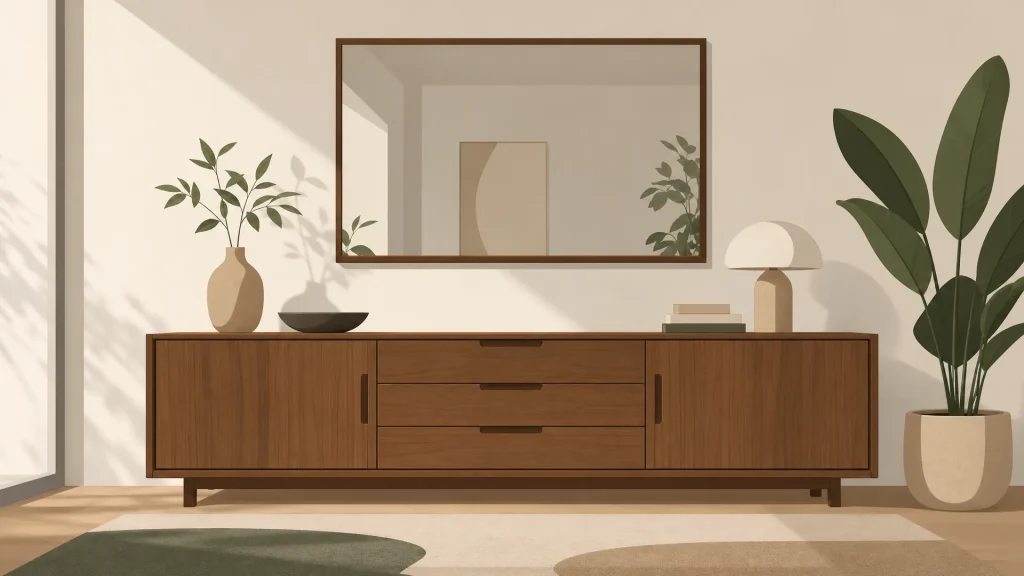
If you only take one number away from this article, make it this one. Leave roughly 15cm to 20cm between the top of the sideboard and the bottom of the mirror.
The 15cm to 20cm gap guideline
This gap is small enough to keep the two pieces visually connected. It’s also large enough that the mirror doesn’t feel like it’s sitting directly on the furniture. In a typical Gauteng dining room with 2.4m to 2.6m ceilings, that 15cm to 20cm gap tends to feel the most balanced. It’s a useful starting point for almost any standard-height room.
If your sideboard already holds a lamp, a tray, or decor pieces, lean toward the larger end of that gap. That gives the objects room to breathe without touching the mirror’s frame.
Centring on eye level vs. centring on the furniture piece
There are two ways to think about vertical placement, and they don’t always agree. One approach centres the mirror on the furniture below it, using that 15cm to 20cm gap as your guide. The other centres the mirror at average eye level, regardless of what’s underneath.
As a rule of thumb, designers often centre the mirror’s midpoint around 145cm to 150cm from the floor, close to average eye level, then adjust down slightly if the sideboard is unusually tall. In most cases, when your sideboard sits at a fairly standard height, both methods land in roughly the same place. The gap should feel intentional, not accidental.
Should the mirror be centred on the wall or on the furniture piece below it? For a sideboard vignette specifically, centre it on the furniture, not the wall. A mirror centred on the wall but off-centre from the sideboard creates the exact visual unease this guide is trying to help you avoid.
Adjusting the Height for Different Sideboard and Server Styles
Not every sideboard is built the same height, and that changes the maths. A tall credenza and a low console call for genuinely different mirror positions, even if the room and ceiling are identical.
Tall credenzas and low, wide consoles
A tall credenza, closer to 90cm in height, leaves less vertical space between its top and the ceiling. Keep the 15cm to 20cm gap here too, but don’t feel pressured to fill every remaining centimetre with a large mirror. A smaller, well-proportioned mirror often looks more considered than one stretched to fill the wall.
A wide, low credenza in a minimalist living room usually calls for a mirror hung slightly lower and wider than you’d expect, so the two pieces read as one vignette rather than two separate items. Because there’s more wall space above a low piece, it’s tempting to hang the mirror much higher just to fill it. Resist that instinct. Keep the gap consistent, and let the empty wall above the mirror stay empty. That negative space is doing real styling work.
If you’re still deciding on the furniture itself, our piece on choosing the right wood credenza walks through how height and depth affect how a credenza lives in a room, before you even get to the mirror above it.
Ceiling height and room proportion considerations
How does ceiling height affect where a mirror should sit above a credenza? In a standard Gauteng home with ceilings around 2.4m to 2.6m, the 15cm to 20cm gap works well without much adjustment. In older homes or double-storey builds with higher ceilings, closer to 3m or beyond, you have more flexibility.
You can push the gap slightly larger, or choose a taller mirror, without the arrangement feeling like it’s floating. In a low-ceilinged flat or apartment, keep the gap tighter and the mirror more modest in scale. This keeps the room from feeling top-heavy. Room proportion matters as much as the individual measurements. If you’re planning a full room refresh, it’s worth looking at broader South African room styles for 2026 before locking in your mirror and sideboard combination.
Mirror Size and Shape: Getting the Proportions Right
Height is only half the equation. Width and shape decide whether the whole arrangement feels proportional once it’s actually on the wall.
Matching mirror width to sideboard width
What size mirror suits a wide sideboard versus a narrow one? As a general guideline, the mirror should span roughly two-thirds to three-quarters of the sideboard’s width. Go much narrower, and the mirror looks lost above a large piece of furniture. Go wider than the sideboard itself, and the whole grouping starts to feel top-heavy.
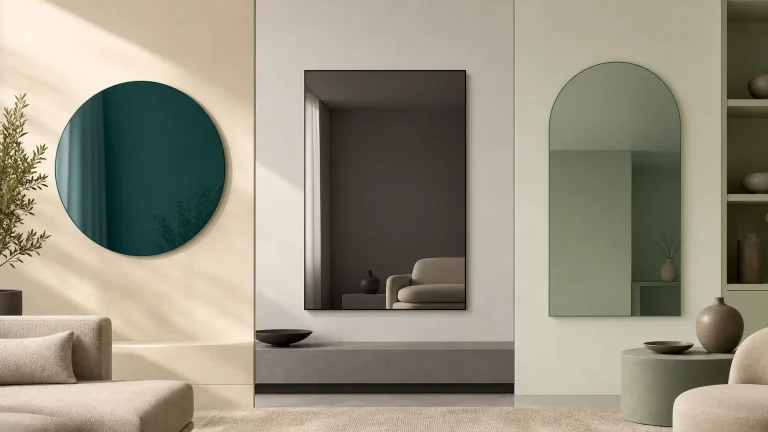
Does a round mirror get hung at a different height than a rectangular one? Round mirrors read as visually lighter than rectangular ones of a similar size, so they can sit slightly higher, or with a marginally smaller gap, without looking out of place. A large round mirror also tends to work better centred precisely over a sideboard’s midpoint, since there’s no frame edge to help the eye judge alignment. With rectangular mirrors, the vertical edges make it more obvious if the piece isn’t sitting straight and centred, so take extra care levelling it during installation.
Common Mistakes to Avoid When Hanging Above a Server
What are the most common mistakes when hanging a mirror above a server? A few issues come up again and again, and most are easy to avoid once you know to look for them.
- Hanging too high. This is the single most common error. It leaves an awkward, empty-looking gap and disconnects the mirror from the furniture below.
- Ignoring reflections and lighting. A mirror hung above a server often reflects windows, ceiling lights, or hallway views. Check what it will actually reflect before you commit to the final position.
- Mismatched frame scale. A delicate, thin-framed mirror can look flimsy above a heavy, substantial credenza. A bold, chunky frame can overwhelm a slim, light console. Match the visual weight of the frame to the visual weight of the furniture.
- Centring on the wall instead of the furniture. As covered above, this is a quiet but very common source of visual unease in dining and living rooms.
- Overcrowding the surface below. If the sideboard top is already busy with decor, a large mirror above it can make the whole vignette feel cluttered rather than calm.
If a calmer, more considered room is the goal, think about the whole space rather than just the mirror. Our approach to calm, functional room decorating covers this kind of restraint in more depth.
Bringing It All Together: A Styled, Balanced Vignette
Once the height, gap, and proportions line up, the change is obvious the moment you walk into the room. The mirror stops looking like a separate object on the wall. It becomes part of one welcoming vignette with the sideboard beneath it.
This is really what good styling comes down to: small, considered decisions that add up to a room feeling right, rather than just filled. Whether you’re working with a compact console in an apartment or a substantial piece like one of our solid Kiaat sideboards and furniture, the same principles of gap, proportion, and centring apply.
If you’re building this vignette from scratch, browse Furnicare’s sideboards, credenzas, and mirrors as a coordinated pair rather than separate purchases. And if you want more confidence beyond this one wall, our mirror placement guide has you covered for every other room in the house too.